Bringing Clarity to Home Construction Payments
At Brick&Bolt, 10% of negative customer ratings were linked to 'Finances not clear', despite customers having access to a transaction history in the app. I was brought in to address this gap in the payment experience.
Through research and cross-functional collaboration, I found structural issues in how financial information was stored and presented. Post-release, finance-related negative customer ratings reduced from 10% to 7%.
ROLE
Research, UX Design, Stakeholder Alignment, Usability Testing, Launch
TIMELINE
4 months
TEAM
3 engineers; worked with Finance and Customer Support Team
Brick&Bolt is a construction-tech marketplace
It helps homeowners build houses end-to-end. Similar to how Uber standardises rides while connecting riders and drivers, Brick & Bolt sits between homeowners and construction partners - owning pricing, quality standards, and customer support.
Because home construction involves high transaction values (~₹80 lakh), payments are collected stage-wise, aligned with construction milestones.
Each stage is ~₹10 lakh
Stages can be further split into flexible instalments
Payments can be made digitally through the platform or directly to the construction partner
This structure means customers continuously track large payments across multiple stages, making clarity critical.
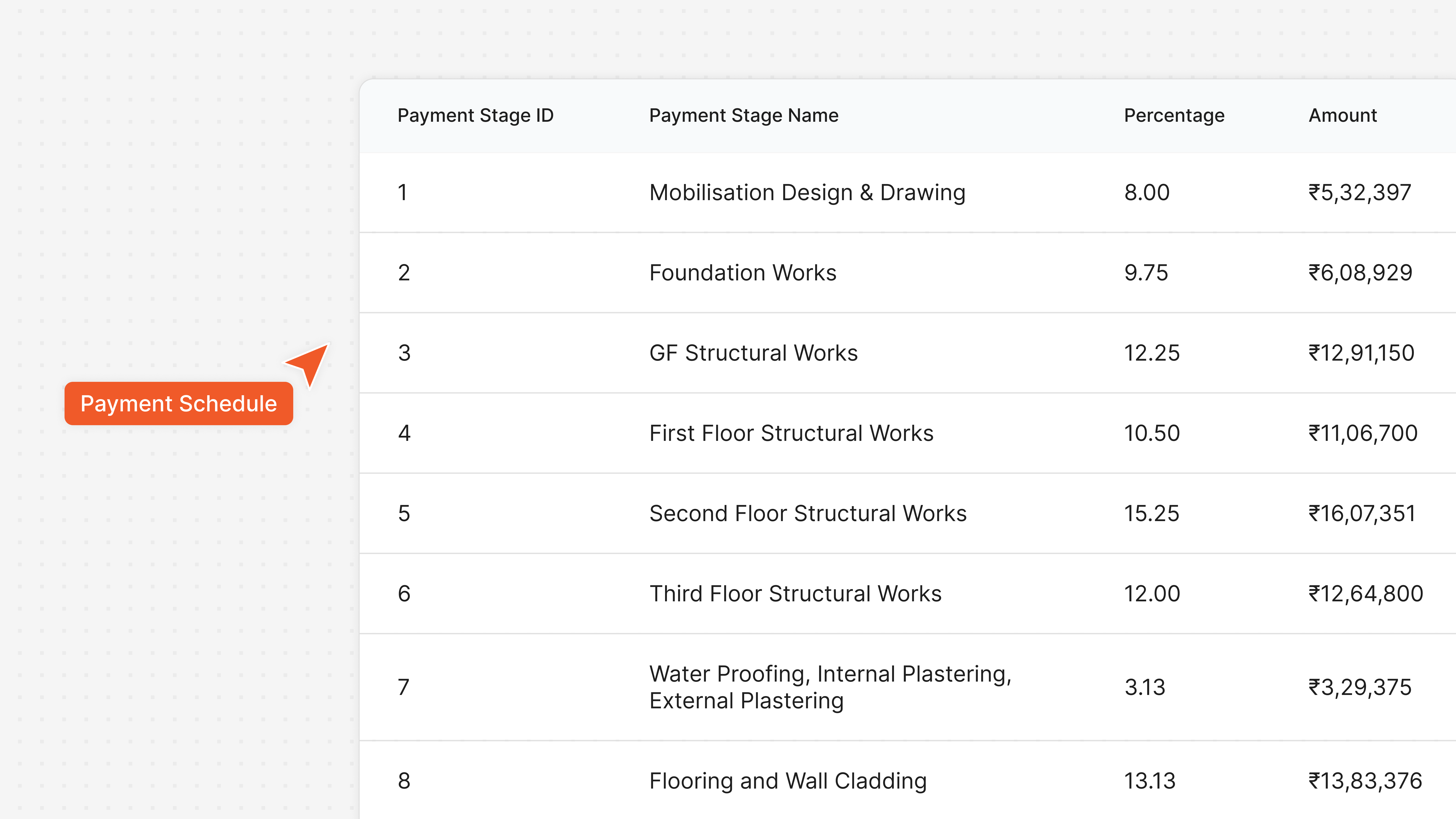
Customers agree to a payment schedule before construction starts
“I paid, but it’s not showing in the app”
To understand why customers felt finances were unclear, I reviewed 6 months of customer support tickets and rating comments, and spoke with the finance and customer support teams. Two core issues consistently surfaced.

Payment status was tracked at the stage level. Until the full stage amount was paid, the stage remained under To be Paid, even if customers had already paid part of it.
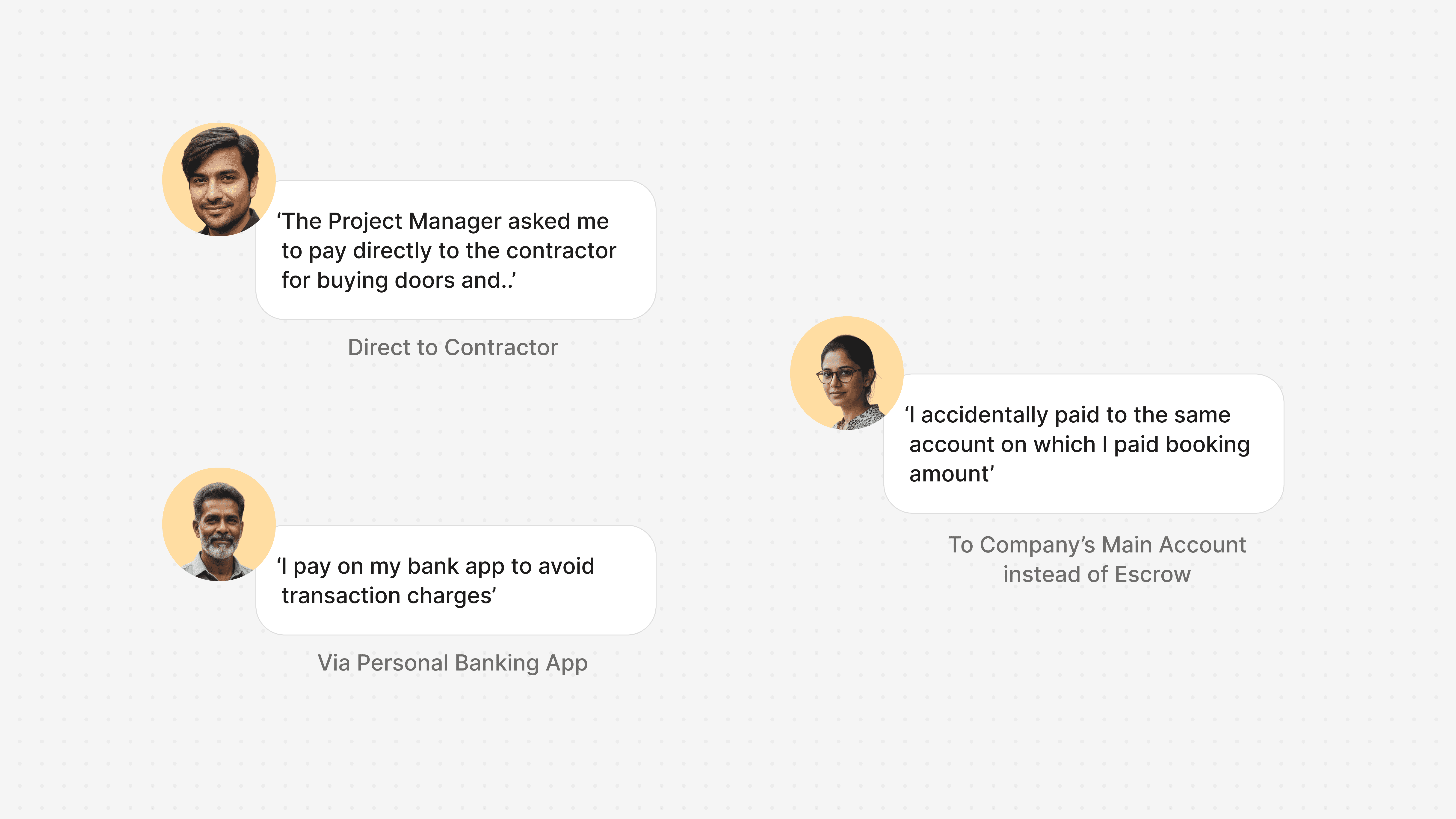
Many customers paid outside the app. Directly to contractors, through personal banking apps, or to Brick&Bolt’s main account instead of their project escrow account. These payments were either reflected in the app only after manual reconciliation or tracked over email and not visible in the app.
The Redesign
While testing early design concepts with customers, I uncovered a few additional sources of confusion. Users found it difficult to quickly understand how much they needed to pay because the payment schedule displayed multiple 'Pay Now' buttons. Some customers were also frustrated by payment gateway charges that only appeared later in the flow. Since the payment experience was already being redesigned, I expanded the scope to address these issues as well to improve overall clarity.
At the same time, the app had several UI inconsistencies, so the new payment screens were designed with a cleaner and more consistent visual language.

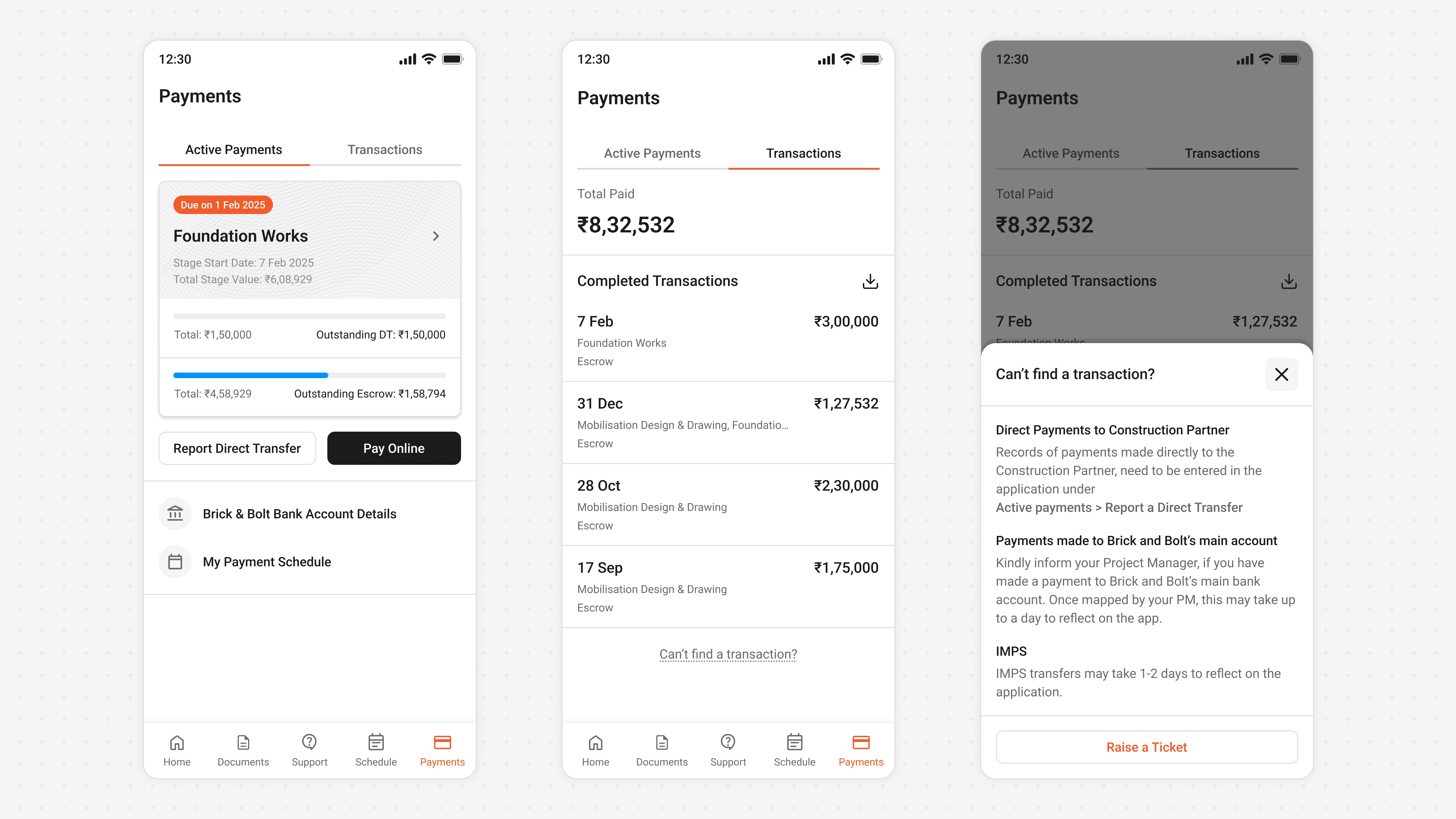
Earlier, payments were mapped to stages, making it hard to understand. The redesign maps transactions directly.

Customers can see exactly what they’ve paid in the Transactions tab. Each entry still retains stage and payment mode, now with clear statuses that were missing earlier.

Customers are guided to report any direct transfers they had made, and the correct bank account details are shown to them on app. This helps digitalise and map payments made outside the app.

Enhanced Active Payments tab

Payment charges are surfaced upfront, reducing surprises during payment.
The Outcome
The redesign was done over 4 months (in 2 phases, Direct Transfer was treated as a separate epic, since it needed its own approval flows and transfer limits).
Payment-related issues reduced from 10% to 7% of total issues.
Not every 'finances not clear' complaint was about payment tracking. Discovery surfaced two other themes that we deliberately kept out of scope: customers questioning pricing because materials (doors, windows etc) seemed cheaper in the open market, and confusion about the wallet balance. The first is a pricing and trust problem rather than a visibility one, and the second needed changes to how wallet credits were calculated and shown, which sat outside this project. With those still in place, the drop reflects the issues this redesign set out to fix.